
Introduction
Location Map
Base Maps
Database Schema
Conventions
GIS Analyses
Glossary
Flowchart
GIS Concepts
Results
Conclusions
References
"Habitat Suitability for Aspen in The Southern Portion of White River National Forest"
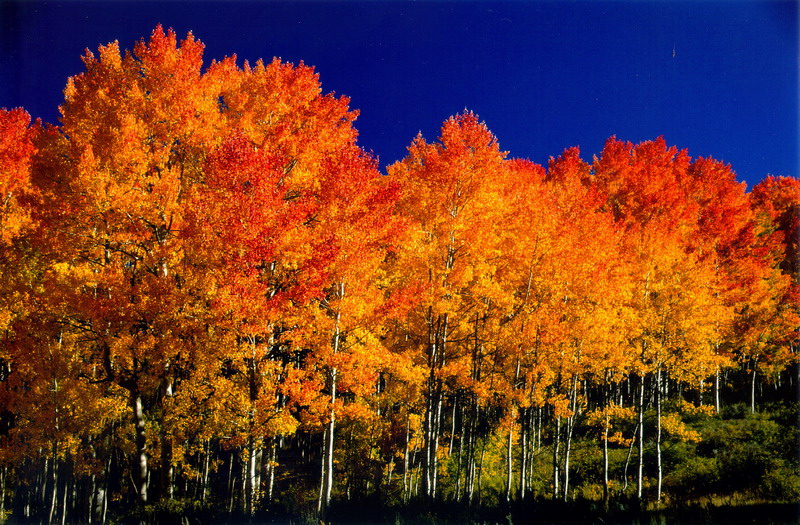
Image Source: images/1707641.htm
Background
In recent statistics provided by the United States Forest Service (USFS), widespread aspen damage has resulted in losses of 17% of the Aspen covertype statewide. Some of the areas where aspen damage has been the greatest include the southwestern and northwestern parts of Colorado. This rapid decline, in combination with widespread beetle kill in Lodgepole pine (Pinus contorta) across many northern portions of the Colorado Continental Divide has caused concern for forest sustainability in future years. Many foresters and researchers are working to evaluate long-term forest responses to stand mortality, regeneration, and site suitability (US Forest Service, 2009).
Aspen dieback has been observed throughout western North America over the past decade. Forest health researchers have documented stand damage in southern Utah (Bartos, 2008), Arizona (Fairweather, M.L., et al, 2008), and the boreal aspen forests of Alberta and Sasketchawan (Hogg, et al, 2008). Worrall, Sheppard, Egeland, and Mask (2008) first observed this phenomenon in Colorado during 2005, and coined the term ‘Sudden Aspen Decline’ (SAD), based on their observation that affected stands were observed to be completely dead within 3-5 years (Worrall, et al, 2008).
There are three hypothetical effects that may be acting synergistically to speed the rates of aspen damage. These include: drought conditions; stand aspect and elevation, and clone susceptibility to disease and damage agents (Worrall, et al, 2008; Bartos, 2008; Hogg, et al, 2008; Fairweather, et al, 2008). Biological agents that may be affecting surviviorship of stands include Cytospora canker, the poplar borer, the bronze poplar borer, and two aspen bark beetle species (Debyle and Norbert, 1985).
Project Goals
Our project focuses on the analysis of select abiotic spatial variables that can impact the suitability of an area to sustain healthy aspen (Populus tremuloides Michx.) populations. For this analysis we have overlayed field-collected stand health data from 2009 and 2010 (Dudley), with raster datasets for environmental parameters to postulate limiting or sustainability effects as a result of these parameters. GIS used in our assessment include data for; soil survey data for the White River National Forest, Maximum Daily Temperature (PRISM), Monthly Precipitation (PRISM), elevation and aspect data (DEM derived).
We used a generalized linear mixed model (using the proc glimmix function in SAS 9.2; Copyright © 2010 SAS Institute Inc., SAS Campus Drive, Cary, North Carolina 27513, USA. All rights reserved) to evaluate relationships between aspen health and various environmental parameters and disease or damage agents. We tested the accuracy of our spatial model with (1) aerial survey data collected from 2006-2009 (Aerial Sketchmapping Program, U.S. Forest Service, Region 2), and (2) a remotely-sensed aspen covertype dataset (obtained from the Colorado Vegetation Classification Project). In summary, we have developed a small-scale prototype of an aspen habitat suitability model that could be applied to a larger area (e.g., state-wide).
Watch our power point presentation about how GIS was used for
modeling habitat suitability for aspen.
Email Project Designers: