Introduction
Location Map
Base Maps
Database Schema
Conventions
GIS Analyses
Glossary
Flowchart
GIS Concepts
Results
Conclusions
References
|
 |
Maximum Summer Temperature:
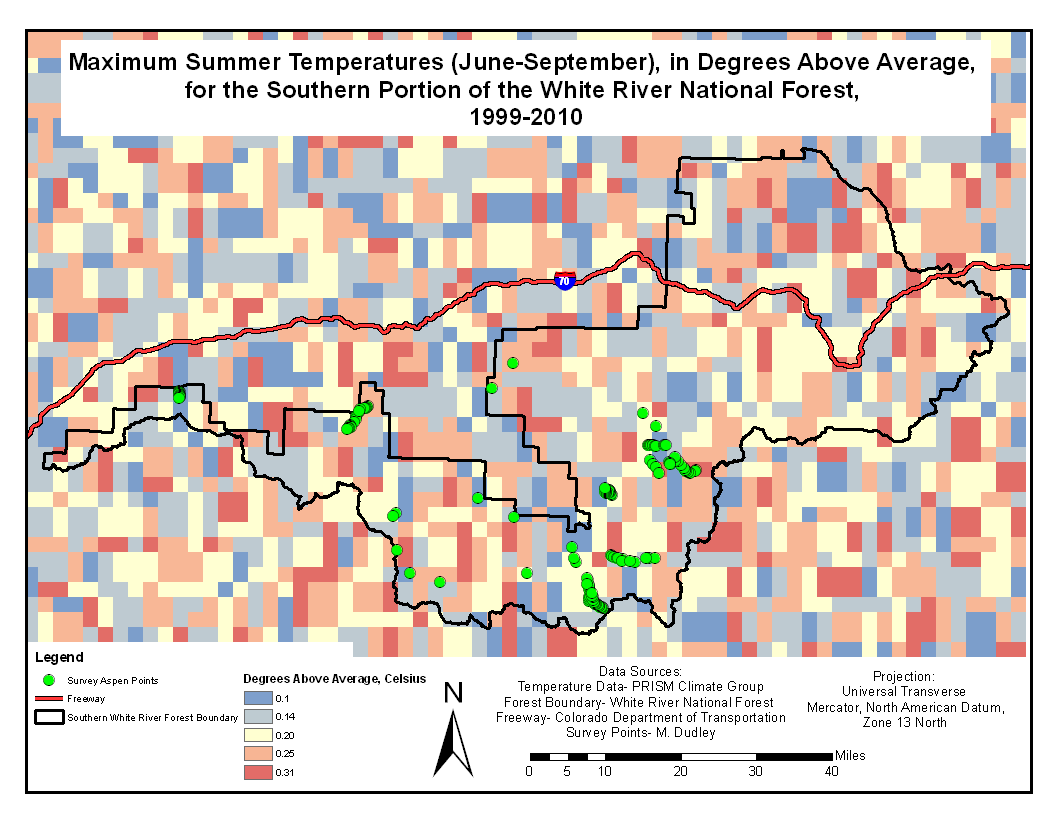
Maximum monthly temperature data was downloaded from the PRISM Climate Group website http://www.prism.oregonstate.edu as nationwide, compressed, monthly datasets for June-September, 1999-2010. Data were extracted and renamed as ASCII files (.asc). We then clipped the unprojected data with an unprojected state boundary shapefile. The clipped datasets were assigned a projection (UTM NAD 83, Zone 13 North) prior to geoprocessing. Each monthly maximum temperature dataset was averaged across years, resulting in four datasets (Average Max June, Average Max July, Average Max August, and Average Max September). To capture the variation in maximum temperature from year to year, each monthly dataset was subtracted from the twelve year average, and then summed, resulting in a single raster dataset of temperature differences for each month. These four data sets (the sum of differences for June, July, August, and September), were then summed, resulting in a single raster dataset with summer temperature differences. We then reclassified the dataset using Jenks’ Natural Breaks method into five categories.
Precipitation:
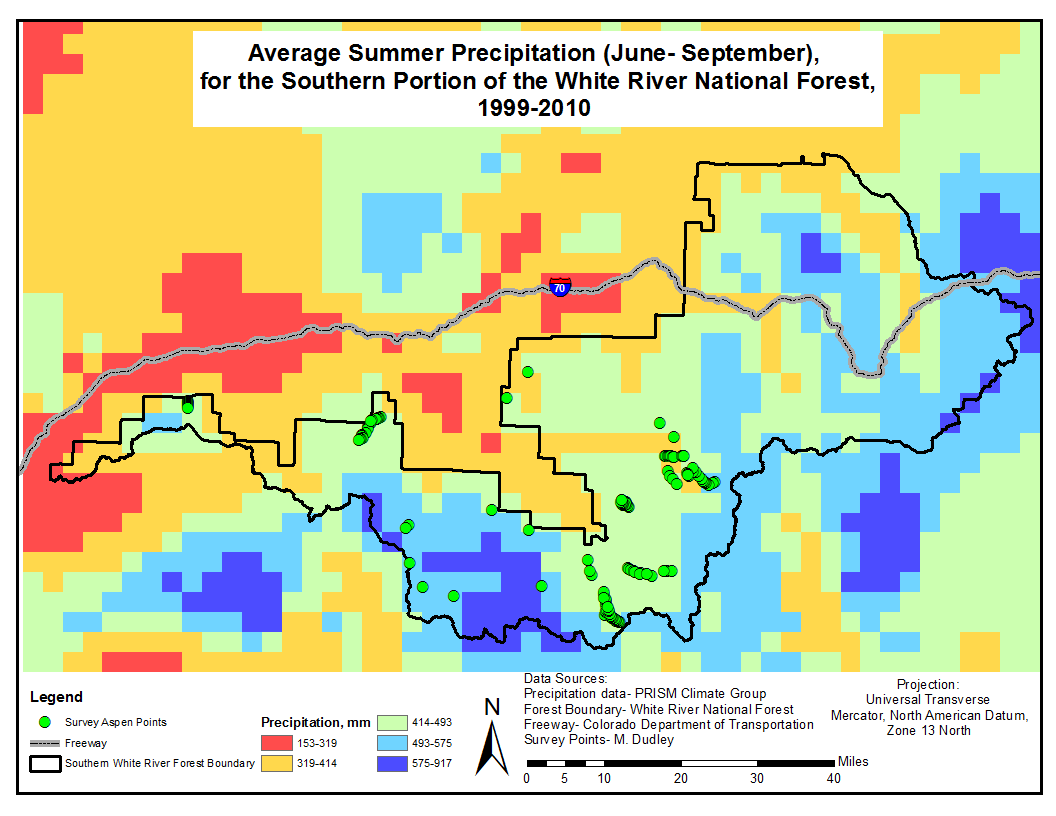
Monthly precipitation data was downloaded from the PRISM Climate Group website http://www.prism.oregonstate.edu as nationwide, compressed, monthly datasets for June-September, 1999-2010. Data were extracted and renamed as ASCII files (.asc). We then clipped the unprojected data with an unprojected state boundary shapefile. The clipped datasets were assigned a projection (UTM NAD 83, Zone 13 North) prior to geoprocessing. Each monthly precipitation dataset was averaged across years, resulting in four datasets (Precip June, Precip July, Precip August, and Precip September). To capture the variation in precipitation from year to year, each monthly dataset was subtracted from the twelve year average, and then summed, resulting in a single raster dataset of precipitation differences for each month. These four data sets (the sum of differences for June, July, August, and September), were then summed, resulting in a single raster dataset with summer precipitation differences. We then reclassified the dataset using Jenks’ Natural Breaks method into five categories. A literature review indicated that minimum precipitation requirements for aspen vary by region (Debyle and Norbert, 1985), thus we did not set a minimum precipitation level in our analysis; rather, we assumed that more precipitation was better than less.
Soils:
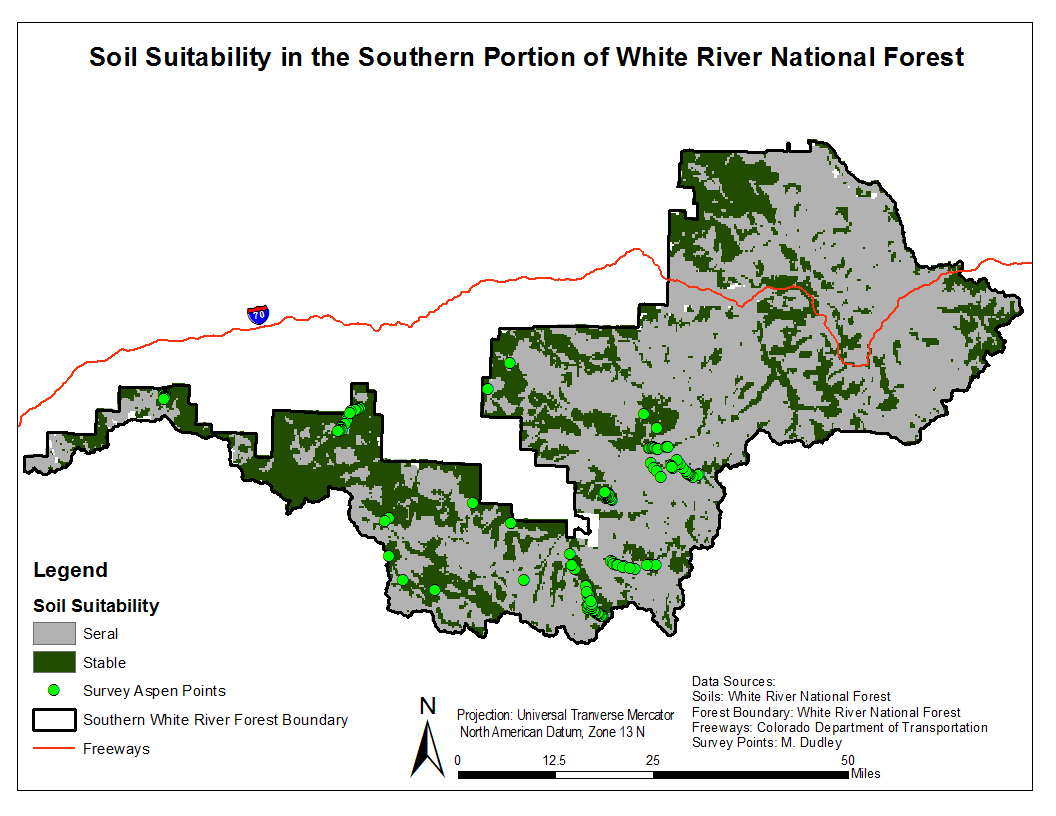
Soil data was downloaded as a forest-specific soil survey from the White River National Forest's website http://www.fs.usda.gov/ in ArcGIS shapefile format, which we converted to a GRID format. Data was only available for the southern portion of the forest. We created a non-spatial table and populated it with information from the soil survey dictionary, a PDF-format document which accompanied the shapefile. This table included: map unit names, ecological units, dominant soil names, climatic zones, and surface soil depth and color. We then joined the non-spatial table to the gridded soil data by the map unit name field. Norbert and Debyle (1985) note that aspen are likely to maintain stable populations on sites with deep and dark-colored surface soils. Based on the soil survey, we selected those units with surface soils that were at least 7 cm deep, and were dark grey, dark brown, dark grey brown, dark red brown, brown, red-brown, or grey-brown in color, and described them as 'Stable', or soils that are likely to be found on sites with long-term (i.e., stable) aspen stands. All other soil types were characterized as 'Seral', or those that are likely to be found on sites with vegetation types other than aspen.
Aspect:
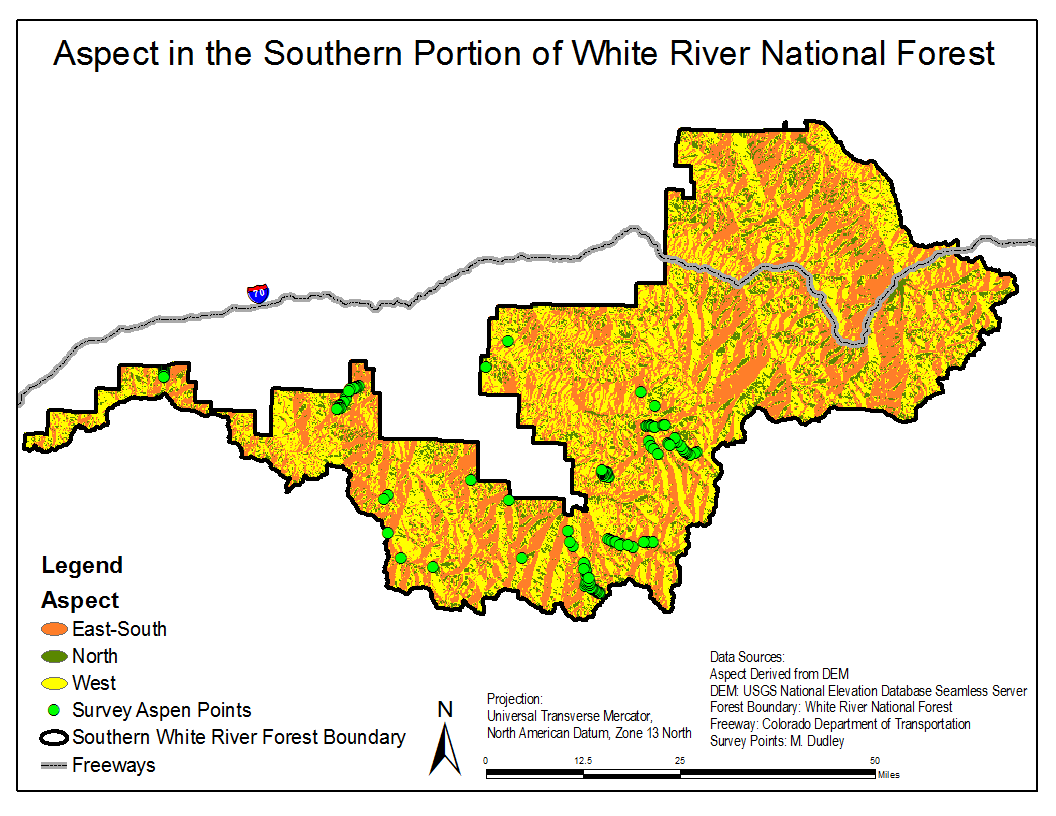
Aspect was derived from a 1/3-arc second Digital Elevation Model (downloaded from the U.S.G.S National Seamless Server website http://seamless.usgs.gov/. Based on field data collected in 2009 and 2010, aspen appear to grow best on north-facing aspects, and worst on west-facing aspects. Aspen on south- or east-facing aspects were in better shape than those on west-facing slopes, and worse than those on north-facing aspects. Thus, for this analysis, we reclassified the aspect data into three categories- north, south and east, and west.
Elevation:
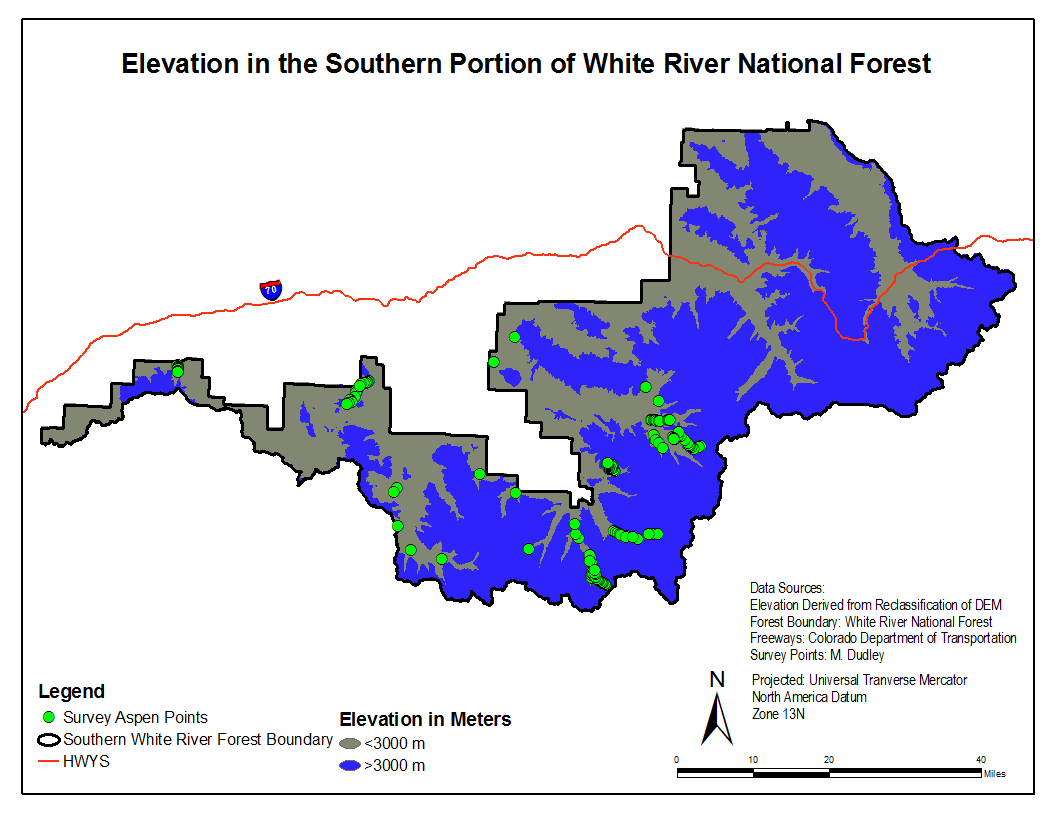
Elevation was derived from a 1/3-arc second Digital Elevation Model (downloaded from the U.S.G.S National Seamless Server website http://seamless.usgs.gov/. Based on field data collected in 2009 and 2010, aspen appear to grow better on higher-elevation sites; analysis indicates that stands located at elevations of 3000 meters or greater have larger proportions of living adult trees than those at lower elevations.