Introduction
Location Map
Base Maps
Database Schema
Conventions
GIS Analyses
Glossary
Flowchart
GIS Concepts
Results
Conclusions
References
Glossary of Terms Used in Project Development
Clip: A command that extracts features from one feature class that reside entirely within a boundary defined by features in another feature class.
Digital Elevation Model (DEM): The representation of continuous elevation values over a topographic surface by a regular array of z-values, referenced to a common datum. DEMs are typically used to represent terrain relief.Feature Classes: In ArcGIS, a collection of geographic features with the same geometry type (such as point, line, or polygon), the same attributes, and the same spatial references. Feature classes can be stored in geodatabases, shapefiles, coverages, or other data formats.
Feature Datasets: In ArcGIS, a collection of feature classes stored together that share the same spatial reference; that is, they share a coordinate system, and their features fall within a common geographic area. Feature classes with different geometry types may be stored in a feature dataset.
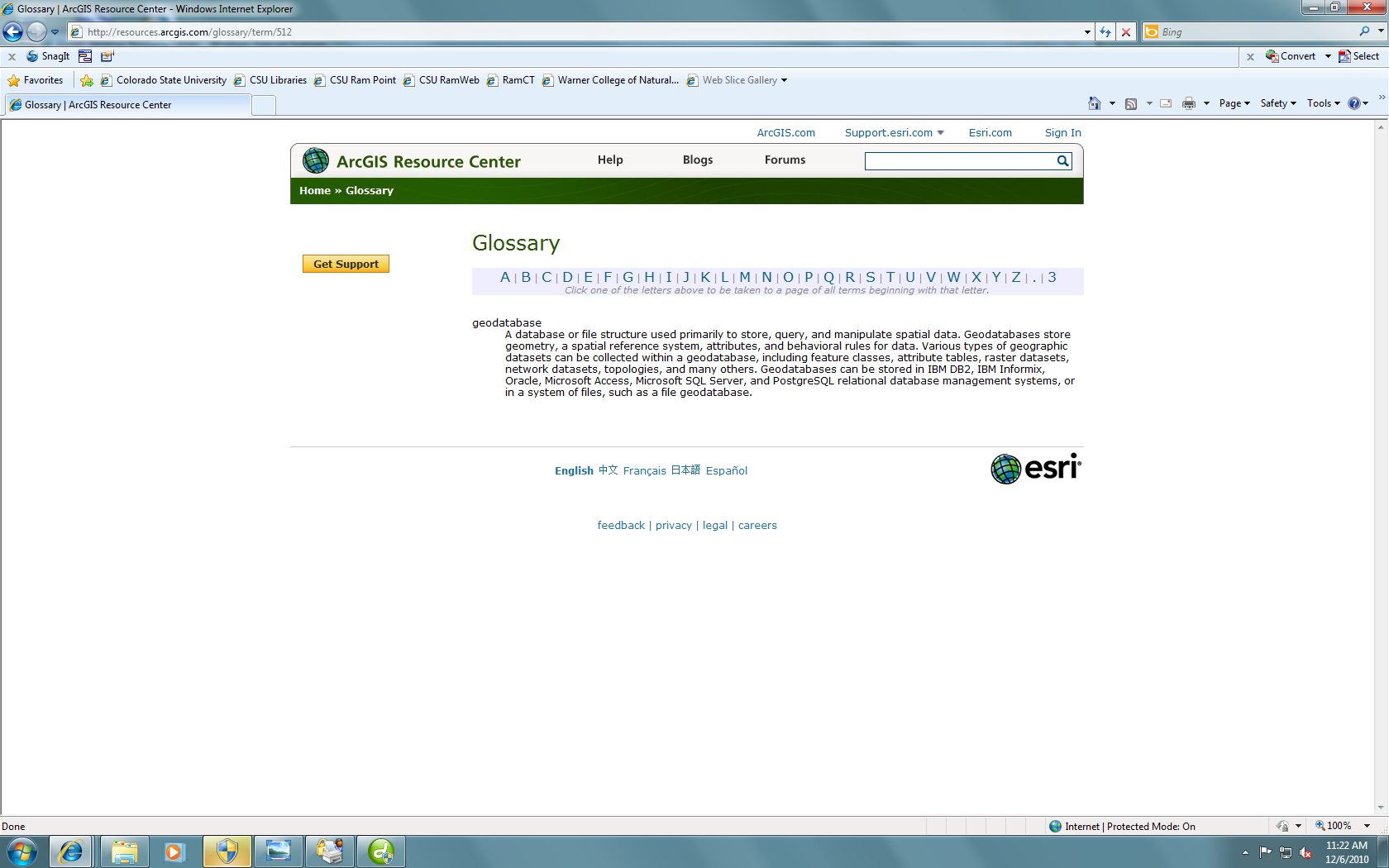
Geodatabase: A database or file structure used primarily to store, query, and manipulate spatial data. Geodatabases store geometry, a spatial reference system, attributes, and behavioral rules for data. Various types of geographic datasets can be collected within a geodatabase, including feature classes, attribute tables, raster datasets, network datasets, topologies, and many others. Geodatabases can be stored in IBM DB2, IBM Informix, Oracle, Microsoft Access, Microsoft SQL Server, and PostgreSQL relational database management systems, or in a system of files, such as a file geodatabase.Geographic Information Systems (GIS): GIS is a system of hardware and software used for storage, retrieval, mapping, and analysis of geographic data.
Geoprocessing: A GIS operation used to manipulate GIS data. A typical geoprocessing operation takes an input dataset, performs an operation on that dataset, and returns the result of the operation as an output dataset. Common geoprocessing operations include geographic feature overlay, feature selection and analysis, topology processing, raster processing, and data conversion. Geoprocessing allows for definition, management, and analysis of information used to form decisions.
Georeferencing: Aligning geographic data to a known coordinate system so it can be viewed, queried, and analyzed with other geographic data. Georeferencing may involve shifting, rotating, scaling, skewing, and in some cases warping, rubber sheeting, or orthorectifying the data.
Grid: In cartography, any network of parallel and perpendicular lines superimposed on a map and used for reference. These grids are usually referred to by the map projection or coordinate system they represent, such as universal transverse Mercator grid.
Line: On a map, a shape defined by a connected series of unique x,y coordinate pairs. A line may be straight or curved.
Point: A geometric element defined by a pair of x,y coordinates.
Projection: A method by which the curved surface of the earth is portrayed on a flat surface. This generally requires a systematic mathematical transformation of the earth's graticule of lines of longitude and latitude onto a plane. Some projections can be visualized as a transparent globe with a light bulb at its center (though not all projections emanate from the globe's center) casting lines of latitude and longitude onto a sheet of paper. Generally, the paper is either flat and placed tangent to the globe (a planar or azimuthal projection) or formed into a cone or cylinder and placed over the globe (cylindrical and conical projections). Every map projection distorts distance, area, shape, direction, or some combination thereof.
Polygon: On a map, a closed shape defined by a connected sequence of x,y coordinate pairs, where the first and last coordinate pair are the same and all other pairs are unique.
Polyline: In ArcGIS software, a shape defined by one or more paths, in which a path is a series of connected segments. If a polyline has more than one path (a multipart polyline), the paths may either branch or be discontinuous.
PNG: Acronym for Portable Network Graphics. A bitmapped graphics format similar to GIF.
Raster: A spatial data model that defines space as an array of equally sized cells arranged in rows and columns, and composed of single or multiple bands. Each cell contains an attribute value and location coordinates. Unlike a vector structure, which stores coordinates explicitly, raster coordinates are contained in the ordering of the matrix. Groups of cells that share the same value represent the same type of geographic feature.
Raster Calculator: An ArcGIS Spatial Analyst tool for performing mathematical calculations with operators and functions, setting up selection queries, or typing Map Algebra syntax. Inputs to the Raster Calculator can be raster datasets, raster layers, coverages, shapefiles, tables, constants and numbers.
Reclassification: The process of taking input cell values and replacing them with new output cell values. Reclassification is often used to simplify or change the interpretation of raster data by changing a single value to a new value, or grouping ranges of values into single values
Shapefile: A vector data storage format for storing the location, shape, and attributes of geographic features. A shapefile is stored in a set of related files and contains one feature class.
Seral: Refers to a vegetative community which undergoes change
Stabile: Refers to an area not readily undergoing ecological change
Vector: A coordinate-based data model that represents geographic features as points, lines, and polygons. Each point feature is represented as a single coordinate pair, while line and polygon features are represented as ordered lists of vertices. Attributes are associated with each vector feature, as opposed to a raster data model, which associates attributes with grid cells.
Please refer to the following link to access the Arc GIS Resource Center
from which many of these definitions were obtained:
http://resources.arcgis.com/glossary