Introduction
Location Map
Base Maps
Database Schema
Conventions
GIS Analyses
Glossary
Flowchart
GIS Concepts
Results
Conclusions
References
Stand Suitability Results
Our final product is a spatial model that incorporates a number of environmental parameters and classifies site suitability on a scale from 1 to 7, with 1 being very poor suitability and 7 being an optimal site for aspen stands. All the parameters used in the construction of our model have been cited in previous studies to have a significant influence on aspen stand health. In their 1985 review of aspen literature, Norbert and Debyle note that surface soils beneath stable aspen stands tend to be deep and dark-colored. Recent studies have shown that elevation and aspect also influence stand health (Worrall, et al, 2008). Following a drought in 2001-2002, Hogg (2008) observed significant increases in stand mortality and branch dieback, reinforcing the idea that aspen do not perform well under high temperatures and low precipitation conditions.
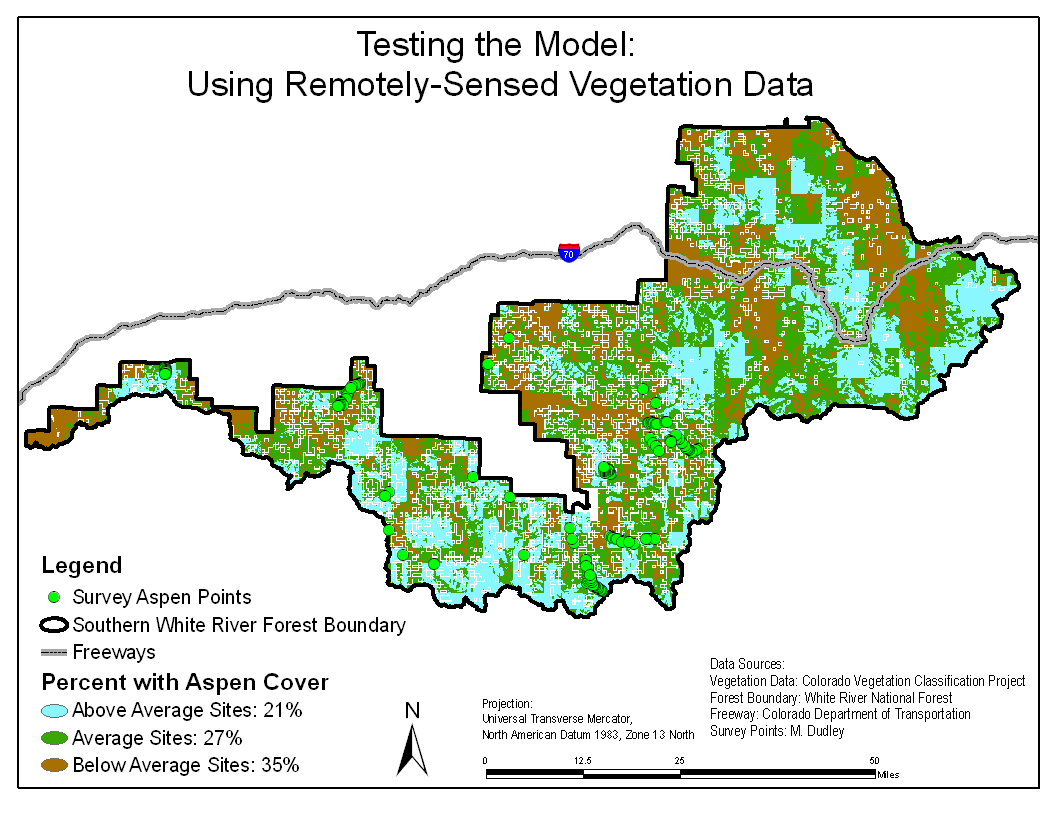
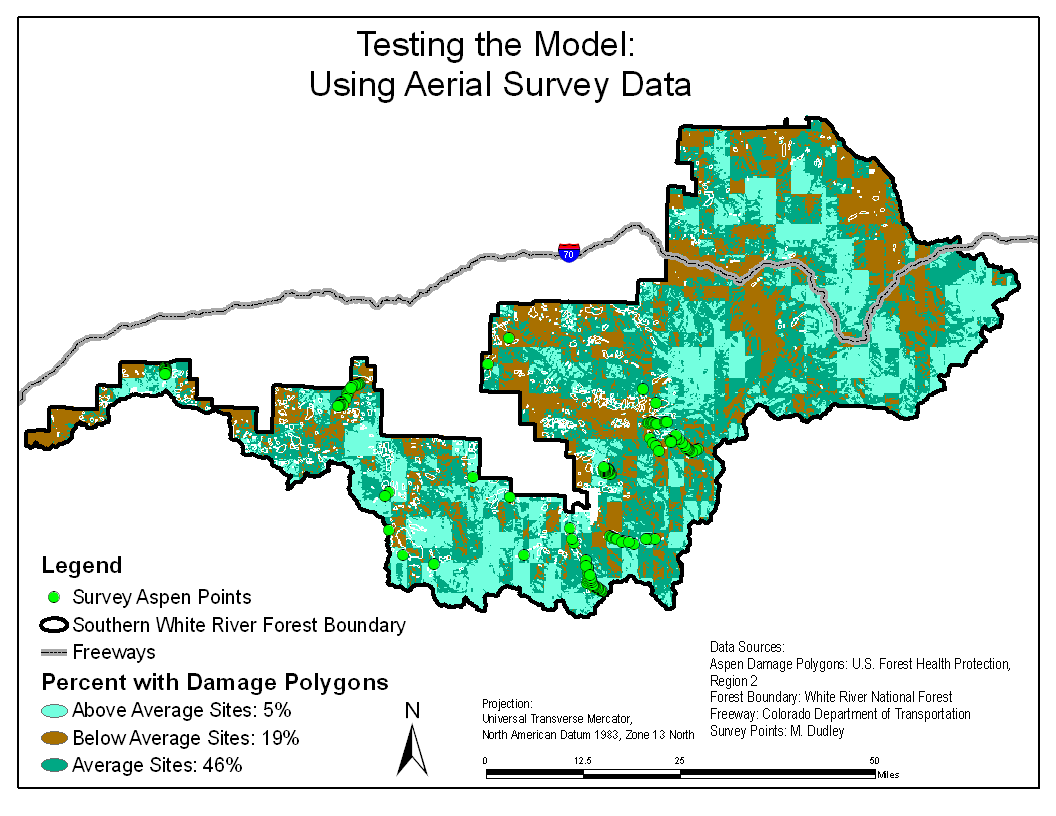
We were pleased to see how well our model performed when tested against aspen damage surveys from the United States Forest Service (USFS) and vegetation covertype data obtained from the Colorado Vegetation Classification Project (CVCP). For model testing, we re-grouped the number of model categories from 7 to 3, where: categories 1-3 were reclassified as ‘below average suitability’, category 4 was classified as ‘average suitability’, and categories 5-7 were classified as ‘above average suitability’. When then tested against the 2006-2009 spatial aerial survey data and our model performed reasonably well. More specifically; 5% of the ‘above average’ areas intersected with damage polygons, 46% of the ‘average’ areas intersected damage polygons, and 19% of the ‘below average’ areas intersected with damage polygons. The model did not perform as well when tested against remotely-sensed vegetation data. Areas classified by the model as being high suitability intersected the aspen covertype only 21% of the time, and areas classified as low suitability intersected the aspen covertype 35% of the time. We suspect, however that the aspen vegetation covertype itself contains false positives, especially in areas where gambel oak (Quercus gambelii) co-occurs with small aspen stands in the northern, lower-elevation portions of the study area (M. Dudley, field observation, 2010). This may explain the high percentage of ‘below average’ model suitability area that intersected with the aspen covertype.