
Introduction
Location Map
Base Map
Database Schema
Conventions
GIS Analyses
Flowchart
GIS Concepts
Results
Conclusion
References

About Us
Your Team Information
Mariana Chapela
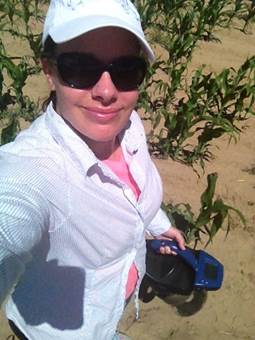
I'm an Agronomist, graduated from Universidad Nacional de Luján, Buenos Aires, Argentina.
I came to Fort Collins, Colorado, in May 2010 to pursue a Masters degree in Integrated Pest Management at Colorado State University. I worked at the Insectary, that is part of the Department of Bioagricultural Sciences and Pest Management, College of Agriculture, Colorado State University. My advisor was Frank B. Peairs.
I finished my Maters in July 2013, and in August of the same year, I started my Ph.D, at the same Department and with the same advisor as my Masters degree. As for now, I'm taking classes and writing the proposal for my Ph.D research.
For my Ph.D I want to determine the presence and amount of infestation of some agricultural pests (Russian Wheat Aphid in wheat, Corn rootworm in corn) using an alternative method to the traditional field sampling. For this purpose I am going to use a sensor (Multiplex® 3) that measures plant fluorescence emission, and in that way, try to determine the presence of the pest by a difference in the fluorescence emitted by the plant. I am going to do most of my research experiments at the Agricultural Research, Development and Education Center (ARDEC), of Colorado State University, located in Fort Collins.
Luis Villalobos
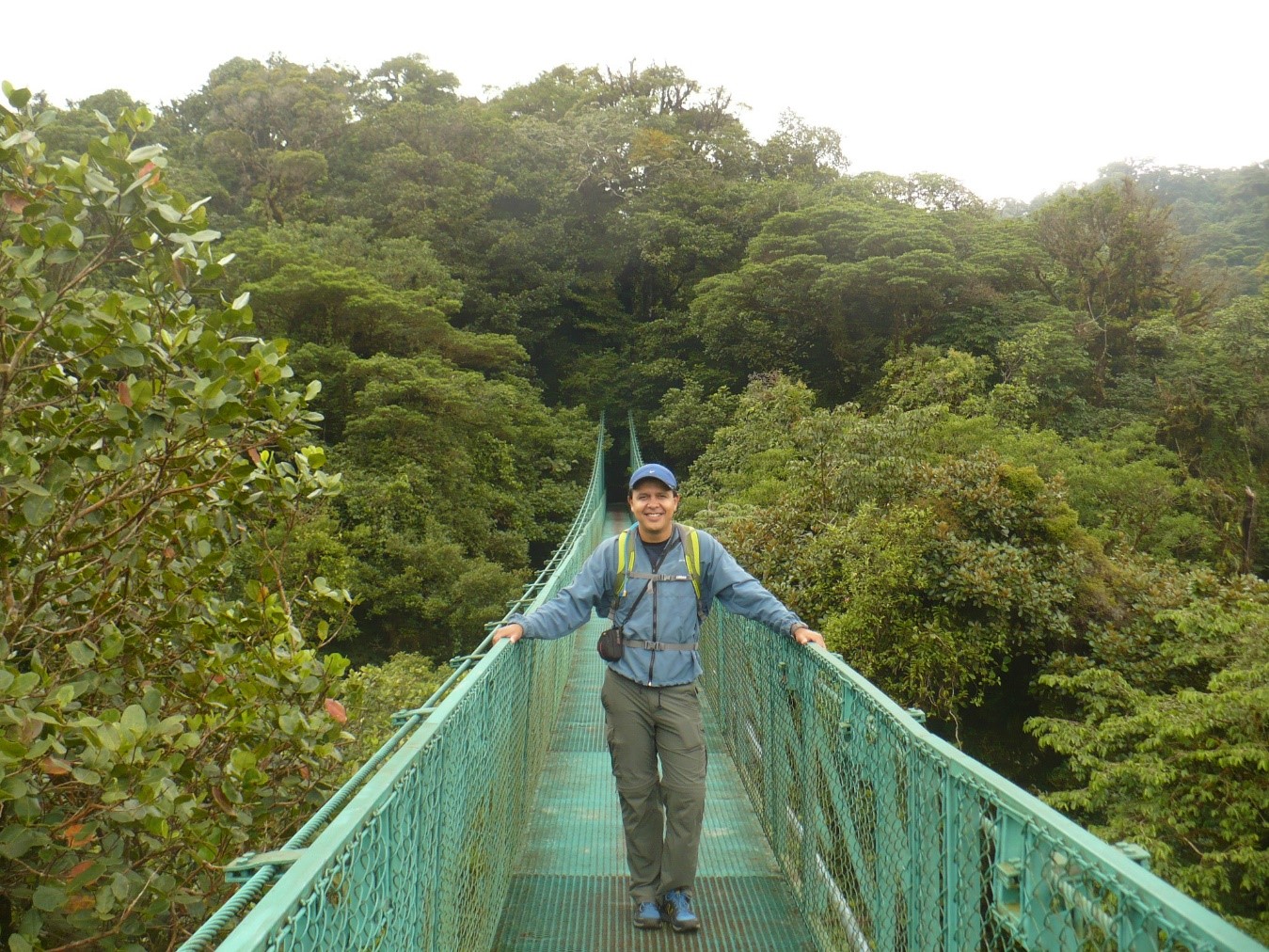
I took my undergraduate and Master degrees in the University of Costa Rica (UCR) with a Major in Animal Sciences (2000-2005) and Agribusiness (2008-2009), respectively. My versatile curriculum allows me to explore new fields in agriculture as well as being aware of the importance of extension programs either in Universities or Government Institutions. My experience in extension has been focused in the integrated analysis of the agroecosystems as well as giving primary importance to the farmers needs.
My research interests and experience have been focused on forage systems as a way to create profitable and environmentally sustainable grazing systems. Different environments have different strengths and weaknesses, which is why an integrated analysis is a tool required to take advantage of the pros available, and learning how to face the cons each farm has. I am a strong believer that extension projects are handy tools in order to maximize the outreach of basic applied research.